
Market Definition
Seed coating colorants are specialized pigments or dyes applied during seed-treatment processes (such as pelleting, film coating or encrusting) to provide visual identification, improve handling, enhance seed flowability, and support regulatory/quality requirements in modern agriculture. They play a supporting role within the broader seed-treatment and seed-coating ecosystem, enabling treated seeds to be easily distinguished and ensuring compatibility with seed-planting equipment and downstream agronomic processes.
Source – https://www.databridgemarketresearch.com/reports/global-seed-coating-colorants-market
Market Outlook
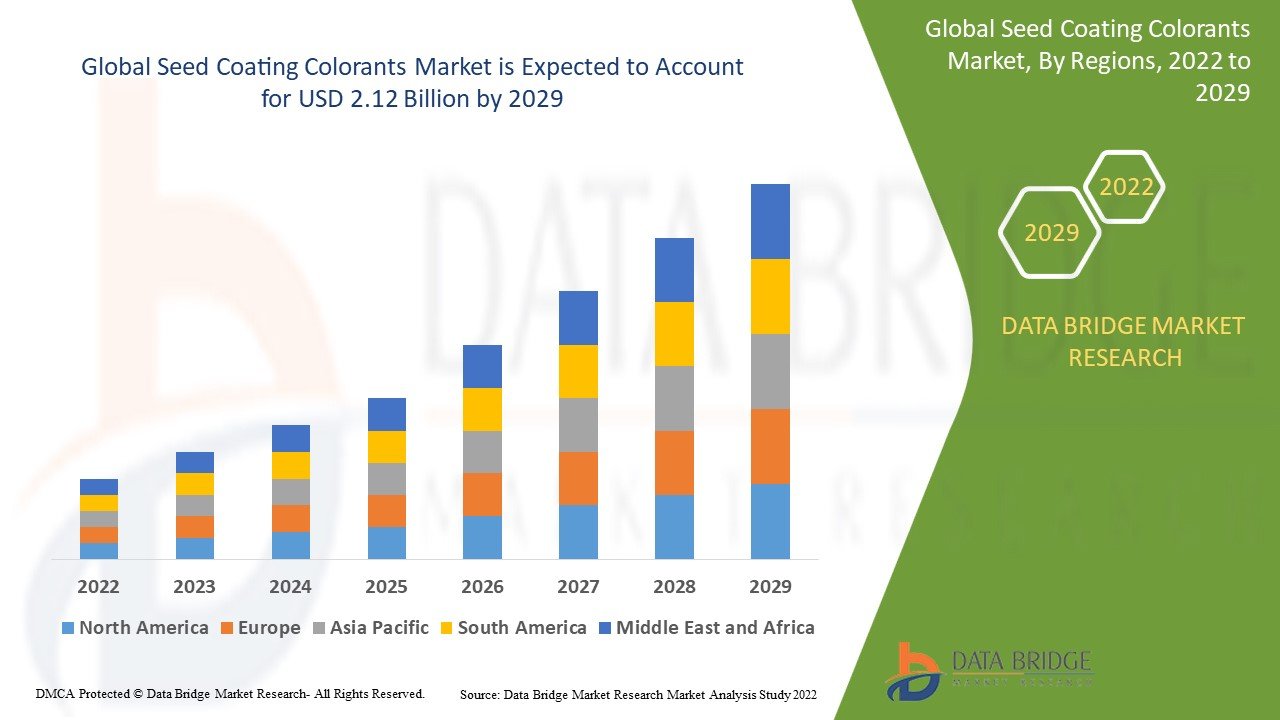
The seed coating colorants market has been expanding steadily as seed-coating and treatment technologies become more widely adopted globally. Key agricultural trends—such as increasing use of treated seeds, higher demands for traceability and visibility, regulatory safety requirements and improved planting practices—are fueling growth. While the market is not among the largest in the agricultural chemical or additive space, it shows consistent value growth and is increasingly important in specialty seed operations, premium crops, and regions with intensive seed treatment practices.
Key Market Drivers
-
Increased use of treated and coated seeds: As farmers and seed-companies adopt more complex seed treatments (fungicides, insecticides, biostimulants), coating operations often incorporate colorants to aid identification and segregation.
-
Visual identification & regulatory compliance: Colorants help distinguish treated from untreated seeds, comply with safety regulations, and support branding and traceability of seed lots.
-
Growth in seed-coating technologies: As film coating, encrusting and pelleting become more common, the demand for compatible colorants that do not interfere with seed performance, germination or treatment efficacy rises.
-
Emerging regional adoption: In regions where seed replacement rate is increasing, and seed-treatment practices are being upgraded, the colorant segment benefits from growth in coated-seed volumes.
-
Innovation and functional colorants: Suppliers are developing colorants that do more than just colour—improving seed flowability, reducing dust, improving adhesion of coatings, and being compatible with biocontrols or ecological seed treatments.
Market Challenges
-
Cost sensitivity and standard seed volumes: In many commodity crops, the incremental cost of premium seed colorants may be a limiting factor, particularly in regions with tight margins.
-
Compatibility and seed-performance issues: Colorants must be compatible with seed coatings, seed treatments and seed germination—any negative impact may lead to reluctance among seed companies.
-
Regulatory and environmental scrutiny: As seed-treatment chemistries face tighter regulations, associated additives including colorants may also face evolving regulatory demands (e.g., on inert ingredients, environmental impact).
-
Slow penetration in some markets: Some regions or crops still use minimal seed-coating operations or use basic colourants; advancing toward higher-end coated-seed operations takes time and education.
Market Segmentation
By Type of Colorant
-
Organic pigments/dyes
-
Inorganic pigments
-
Synthetic or semi-synthetic colourants
By Formulation/Form
-
Dry powder or granules
-
Liquid dispersions
-
Emulsifiable or water-based formulations
By Crop/Application
-
Major field crops (cereals, grains)
-
Oilseeds and pulses
-
Vegetables, fruits and horticulture
-
Ornamental seeds and turf/forage
By Geography
-
North America
-
Europe
-
Asia-Pacific
-
Latin America
-
Middle East & Africa
Regional Insights
-
The North American region has been a leading market due to the high degree of seed treatment adoption, large seed companies, well-developed seed-coating infrastructure and stringent traceability/regulatory practices.
-
Asia-Pacific is emerging as a high-growth region, supported by increasing seed-replacement rates, modernization of agriculture, expansion of seed-treatment practices and growth in coated-seed volumes in countries such as China and India.
-
Europe shows steady demand, with emphasis on seed-quality, safety standards, and increasing adoption of advanced seed-coating and treatment methods (including colorants).
-
Other regions (Latin America, Middle East & Africa) present growth potential but may face challenges in seed-coating infrastructure, awareness and cost sensitivity.
Key Trends
-
Functional colourants: Beyond mere identification, colourants that contribute to improved seed flow, coating adhesion, dust suppression or improved handling are gaining attention.
-
Eco-friendly and biodegradable formulations: As agriculture seeks more sustainable inputs, colourants with lower environmental impact or derived from safer chemistries are increasingly valued.
-
Customization and brand differentiation: Seed companies and growers value colourants that can be matched to specific seed coatings, brand colours or specialized seed types (premium, hybrid, speciality crops).
-
Growth in specialty seeds & high-value crops: Vegetable, fruit and horticultural seed segments typically use more advanced coating and colourant technologies, so colorant demand is growing in these segments faster than in commodity seeds.
-
Integration with seed-treatment supply chain: Colourants are being offered as part of bundled seed‐coating packages (coating formulation + colourant + seed treatment + performance guarantee) by suppliers, simplifying procurement for seed companies.
Competitive Landscape
The market is composed of chemical and pigment suppliers, additive formulators, coating system providers, and seed‐treatment solution companies. Leading players focus on colourant performance, seed-coating compatibility, regulatory compliance, and regional supply networks. Strategic activity includes partnerships with seed-coating formulators, development of new colorant grades for emerging crops, and expansion of manufacturing footprint in high-growth regions.
Strategic Considerations
For Colourant Suppliers
-
Develop colorants optimized for seed-coating environments: strong adhesion, dust suppression, high visibility, compatibility with seed coatings and treatments.
-
Expand into high-growth regions by aligning with local seed-treatment players and establishing regional supply/manufacturing.
-
Focus on sustainable and regulatory-compliant technologies to meet evolving consumer and regulatory demands.
-
Offer value beyond colour: performance improvements (seed flow, handling), differentiation and compliance support to seed companies.
For Seed Companies & Coaters
-
Evaluate colourant suppliers not just on cost but on performance (coating adhesion, seed flow, planting equipment compatibility) and regulatory standing.
-
Leverage colourants as part of differentiated seed product offerings (premium seeds, brand seed lots) and for improved farm operational efficiency (e.g., easier handling, identification).
-
Monitor emerging crops, regional seed-replacement trends and coated seed adoption to plan colourant procurement strategically.
For Investors
-
Focus on businesses that combine colourant manufacturing with seed-coating know-how and regional presence in emerging seed markets.
-
Prioritize players with innovation in eco-friendly, high-performance colourants tailored for specialised seeds and offering growth in high-value segments (vegetables, horticulture).
-
Consider the broader seed-treatment and seed-coating market trajectory—colourants are a supporting component so their growth links to coated-seed adoption, which depends on agriculture modernization.
Conclusion
The seed-coating colourants market is a specialized yet vital part of modern seed-treatment and seed‐coating operations. Driven by coated-seed adoption, demand for treated seeds, visual identification and improved handling, the market offers steady growth opportunities. While commodity crops and mature regions show moderate growth, the biggest upside lies in specialty seed types, advanced coatings, eco-friendly formulations and emerging agricultural regions. Suppliers and seed companies that invest in performance, sustainability and tailored regional strategies will be best positioned to capture value in this growing market.