
United States Fast Food & Quick Service Restaurant Market Overview
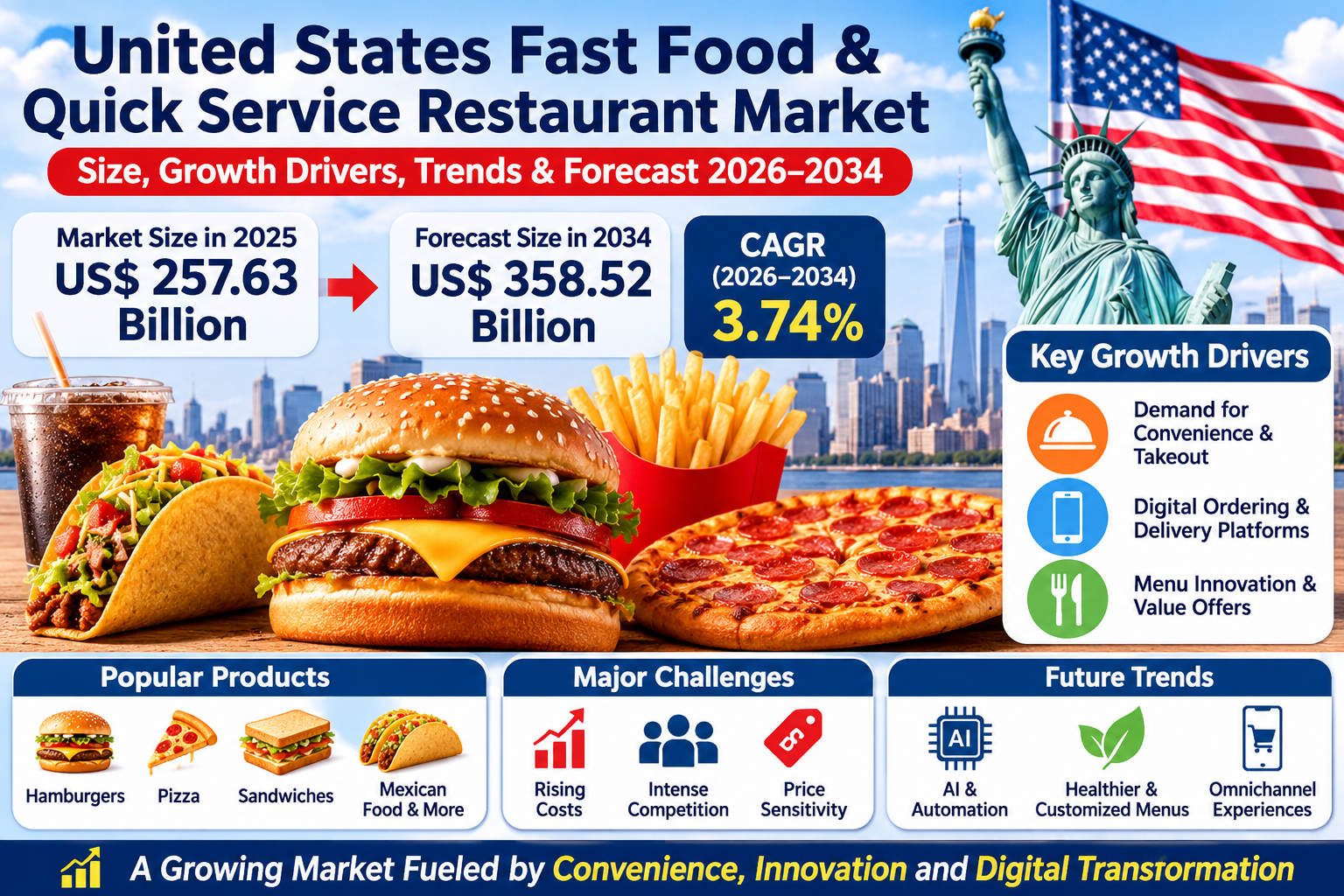
The United States Fast Food & Quick Service Restaurant (QSR) Market is experiencing steady growth as consumers increasingly seek convenient, affordable, and accessible dining options. According to the supplied market estimates, the industry is projected to expand from US$257.63 billion in 2025 to US$358.52 billion by 2034, registering a compound annual growth rate (CAGR) of 3.74% during 2026–2034.
Market expansion is supported by changing consumer lifestyles, increasing demand for takeaway and delivery, mobile ordering, drive-thru services, and continuous menu innovation. Restaurant operators are also investing in digital ordering applications, self-service kiosks, loyalty programs, automated operations, and personalized promotions to improve customer experiences and operational efficiency.
The U.S. fast food industry includes burgers, sandwiches, pizza, Mexican food, fried chicken, breakfast products, snacks, desserts, and beverages. Established restaurant chains compete with regional brands, independent operators, fast-casual businesses, and digital-first foodservice providers.
Although rising labor expenses, ingredient prices, and intense competition create challenges, technology adoption, value-oriented menus, and expanding off-premises consumption continue to create opportunities for the industry.
What Is the Fast Food and Quick Service Restaurant Market?
Fast food and quick service restaurants are foodservice establishments designed to prepare and serve meals quickly through counter service, drive-thru facilities, takeaway, delivery, and digital ordering platforms.
Unlike traditional full-service restaurants, QSRs generally operate with standardized menus, streamlined kitchen processes, limited table service, and relatively short waiting times.
Common product categories include:
- Hamburgers and cheeseburgers
- Sandwiches and wraps
- Pizza and other baked products
- Mexican-inspired food, including tacos and burritos
- Fried chicken and other poultry products
- Breakfast meals, snacks, desserts, and beverages
QSRs are popular in the United States because they accommodate busy schedules, commuting, workplace meals, family dining, and on-the-go consumption. Mobile applications and delivery services have further expanded access to restaurant products.
According to the National Restaurant Association figures cited in the supplied research, 47% of U.S. adults used restaurant takeout weekly in 2025, while 42% used drive-thru services and 37% used delivery services weekly. These figures demonstrate the importance of convenience-oriented dining.
Key Growth Drivers of the United States Fast Food & QSR Market
1. Increasing Demand for Convenience and Off-Premises Dining
Convenience remains one of the most important growth drivers in the U.S. fast food market. Consumers increasingly prefer dining solutions that reduce waiting times and fit around work, education, commuting, and family responsibilities.
Drive-thru facilities, pickup counters, takeaway services, and home delivery allow customers to purchase meals without spending considerable time inside restaurants.
The increasing importance of off-premises dining is encouraging operators to expand digital ordering, improve packaging, optimize pickup processes, and establish partnerships with delivery platforms. Restaurants are also redesigning their kitchens and service areas to manage dine-in and digital orders efficiently.
2. Digital Ordering, Mobile Applications, and Delivery
Digital transformation is changing how consumers discover restaurants, place orders, make payments, and receive food.
Restaurant applications, online ordering websites, third-party delivery platforms, digital wallets, and self-service kiosks have become important components of the QSR business model.
The supplied research reports that 57% of U.S. adults had recently used mobile ordering in 2025, increasing to 74% among millennials and 65% among Generation Z adults.
These technologies help restaurants reduce ordering friction, personalize promotions, manage customer relationships, and encourage repeat purchases. Loyalty applications also enable brands to provide customized offers based on ordering patterns and customer preferences.
Going forward, artificial intelligence, automated order processing, and integrated restaurant management systems may further improve operational efficiency and customer engagement.
3. Menu Innovation and Affordable Value Offers
Menu innovation helps restaurant operators attract new customers and retain existing ones. Consumers increasingly expect variety, customization, seasonal products, premium ingredients, healthier choices, and affordable meal combinations.
Restaurants are responding with limited-time offerings, breakfast menus, plant-based alternatives, specialty beverages, premium burgers, customized sandwiches, and family meal bundles.
Affordability is particularly important when households face pressure from food prices and other living expenses. Discounts, loyalty rewards, combination meals, and promotional pricing can encourage customers to choose branded restaurants more frequently.
Successful operators must balance affordability with food quality, portion sizes, service speed, and profitability.
Major Challenges Facing the U.S. Fast Food Market
Rising Labor and Operating Costs
Labor, food ingredients, rent, utilities, packaging, insurance, equipment, and technology create significant operating expenses for restaurant businesses.
Higher costs can reduce profit margins, especially when customers are unwilling to accept corresponding menu price increases. Recruiting and retaining employees also remains a challenge for restaurant operators.
To address these pressures, companies are investing in employee training, efficient staffing models, self-service kiosks, kitchen automation, and streamlined preparation processes. These initiatives can improve productivity while helping businesses maintain service standards.
Intense Competition and Price Sensitivity
The U.S. QSR industry includes national restaurant chains, regional operators, independent restaurants, convenience stores, grocery retailers, fast-casual brands, and delivery-based businesses.
Consumers can compare prices, menus, ratings, delivery fees, and promotions through digital platforms, making customer loyalty harder to maintain.
Restaurant operators must therefore differentiate themselves through recognizable branding, consistent food quality, convenient locations, competitive pricing, effective loyalty programs, and innovative menus.
United States Fast Food Market: Key Product Segments
The market can be segmented into hamburgers, sandwiches, pizza, Mexican food, and other products.
Hamburgers
Hamburgers remain a major category because of their widespread consumer acceptance, customization options, and availability across different price points.
According to QSR Magazine’s 2026 QSR 50 ranking cited in the supplied research, McDonald’s generated US$55.06 billion in U.S. systemwide sales in 2025, followed by Wendy’s at US$11.90 billion and Burger King at US$11.07 billion.
Premium burgers, specialty sauces, chicken alternatives, plant-based options, and value meals provide opportunities for further product differentiation.
Pizza
Pizza benefits from customization, group consumption, takeaway, delivery, and promotional meal bundles.
The supplied research estimates that the U.S. pizza restaurant industry had more than 75,700 businesses in 2025, with an industry market size of approximately US$49.45 billion.
Major competitors include Domino’s, Pizza Hut, Little Caesars, and Papa Johns. Digital ordering, loyalty programs, family bundles, specialty crusts, and premium toppings remain important competitive strategies.
Sandwiches
Sandwiches and wraps appeal to consumers seeking portable and customizable meals for breakfast, lunch, dinner, and snacks.
Operators can differentiate their products through grilled chicken, deli-style ingredients, fresh vegetables, specialty breads, vegetarian alternatives, and healthier menu combinations.
Subway, Panera, Arby’s, and Jersey Mike’s are among the important brands identified in the supplied research. Mobile ordering and convenient pickup support continued demand for sandwich-focused QSR concepts.
Mexican Food and Other Products
Mexican-inspired products, including tacos, burritos, and customized bowls, contribute to menu diversity. Other categories include fried chicken, salads, breakfast products, desserts, and beverages.
Restaurants can attract additional customer groups through regional flavors, dietary alternatives, seasonal menus, and value-oriented combinations.
Regional Opportunities Across the United States
Demand conditions vary across states according to population, tourism, commuting patterns, consumer preferences, and restaurant competition.
- California: A diverse consumer base and technology-oriented restaurant environment create opportunities for digital ordering, plant-based products, customization, and premium menu innovation.
- Texas: Population growth, suburban development, automobile-oriented travel, and strong demand for regional flavors support drive-thru and convenient dining formats.
- Florida: Tourism, population expansion, and seasonal visitor activity increase demand for accessible restaurants in metropolitan areas and tourism destinations.
- New York: Dense urban communities, workplaces, transport hubs, and tourism support demand for quick meals, takeaway, delivery, and compact restaurant formats.
- Illinois, Pennsylvania, Georgia, Virginia, and other states: Regional population centers, employment activity, and established restaurant networks provide opportunities for national and regional operators.
According to the supplied research, Maryland, New Mexico, Alabama, West Virginia, and Virginia rank among the five states with the highest reported percentages of fast food restaurants within their restaurant establishments. The respective reported shares are 46.76%, 42.02%, 40.76%, 40.01%, and 39.99%.
Competitive Landscape and Leading Companies
The U.S. fast food and QSR market is characterized by established brands, extensive restaurant networks, recognizable menus, and increasing investment in technology and customer engagement.
Major companies covered in the supplied research include:
- McDonald’s
- Pizza Hut, LLC
- KFC Corporation
- Domino’s Pizza, Inc.
- Taco Bell IP Holder, LLC
- Chick-fil-A, Inc.
- Starbucks
- Chipotle Mexican Grill
Competition is shaped by pricing, restaurant locations, menu innovation, digital accessibility, delivery capabilities, brand recognition, and customer loyalty.
Leading operators increasingly use mobile applications, personalized promotions, digital payments, loyalty programs, and limited-time products to increase order frequency. Smaller businesses can compete by focusing on local preferences, specialized menus, efficient service, and differentiated customer experiences.
Company-level competitive assessments commonly examine business overviews, key personnel, recent developments, SWOT analysis, and revenue performance.
Emerging Trends and Future Market Opportunities
Artificial Intelligence and Restaurant Automation
AI-enabled demand forecasting, automated order management, and inventory optimization can help restaurants reduce waste and improve service efficiency. Self-service kiosks and digital ordering systems also allow customers to customize orders more conveniently.
Health-Conscious and Customized Menus
Growing interest in ingredient transparency, portion control, fresh vegetables, plant-based alternatives, and dietary flexibility is encouraging menu diversification. Restaurants that combine convenience with appealing food choices may strengthen their competitive position.
Omnichannel Customer Experiences
Consumers increasingly expect consistent experiences across restaurant apps, websites, delivery platforms, loyalty programs, and physical locations. Integrating these channels can simplify ordering, improve customer retention, and provide better insights into purchasing behavior.
Data-Driven Marketing and Loyalty
Personalized offers, membership rewards, targeted promotions, and digital campaigns help restaurants encourage repeat purchases. Effective use of customer data, subject to applicable privacy requirements, can improve marketing efficiency and customer engagement.
Market Segmentation
The United States Fast Food & Quick Service Restaurant Market can be analyzed through the following categories.
By product: Hamburgers, sandwiches, pizza, Mexican food, and others.
By geography: California, Texas, New York, Florida, Illinois, Pennsylvania, Ohio, Georgia, New Jersey, Washington, North Carolina, Massachusetts, Virginia, Michigan, Maryland, Colorado, Tennessee, Indiana, Arizona, Minnesota, Wisconsin, Missouri, Connecticut, South Carolina, Oregon, Louisiana, Alabama, Kentucky, and the rest of the United States.
By competitive analysis: Company overview, key personnel, recent developments, SWOT analysis, and revenue analysis.
Conclusion
The United States Fast Food & Quick Service Restaurant Market is positioned for steady expansion, with market value projected to increase from US$257.63 billion in 2025 to US$358.52 billion by 2034, at a CAGR of 3.74% during 2026–2034.
Convenience-oriented dining, digital ordering, delivery, value meals, menu customization, and restaurant technology are central to the industry’s growth outlook. However, rising operating expenses, price-sensitive consumers, and intense competition will continue to influence business performance.
Companies that combine efficient operations, competitive pricing, customer-focused digital experiences, and relevant menu innovation will be better positioned to capture opportunities in the evolving U.S. QSR market.
Frequently Asked Questions (FAQs)
1. What is the projected size of the United States Fast Food & QSR Market by 2034?
The market is projected to reach US$358.52 billion by 2034, increasing from US$257.63 billion in 2025.
2. What is the CAGR of the U.S. fast food market?
The market is forecast to grow at a compound annual growth rate of 3.74% during 2026–2034.
3. What are the main drivers of market growth?
Key drivers include demand for convenient meals, takeaway and delivery services, mobile ordering, drive-thru facilities, menu innovation, loyalty programs, and affordable promotional offers.
4. Which products are included in the U.S. QSR market?
Major segments include hamburgers, sandwiches, pizza, Mexican food, and other fast food products such as chicken, breakfast meals, snacks, and beverages.
5. What challenges affect the U.S. fast food industry?
The main challenges include rising labor and ingredient costs, increasing operating expenses, strong competition, changing consumer preferences, and sensitivity to menu prices.
6. Which companies are major players in the U.S. fast food market?
Major companies covered in the research include McDonald’s, Pizza Hut, KFC, Domino’s Pizza, Taco Bell, Chick-fil-A, Starbucks, and Chipotle Mexican Grill.
7. How is technology changing the U.S. QSR industry?
Mobile applications, digital payments, self-service kiosks, delivery integrations, AI-enabled forecasting, and loyalty programs are improving convenience, operational efficiency, and customer engagement.
8. What are the major future trends in the U.S. fast food market?
Important trends include AI adoption, restaurant automation, digital-first ordering, personalized promotions, healthier menu alternatives, customization, and integrated omnichannel experiences.
Research source: Renub Research, United States Fast Food & Quick Service Restaurant Market Size and Forecast.
Report link: https://www.renub.com/fast-food-market-p.php
Editorial note: Market forecasts and statistics are based on the supplied research text. Verify individual third-party statistics, definitions, and publication dates before publication, particularly where figures refer to different industry segments or measurement methods.