
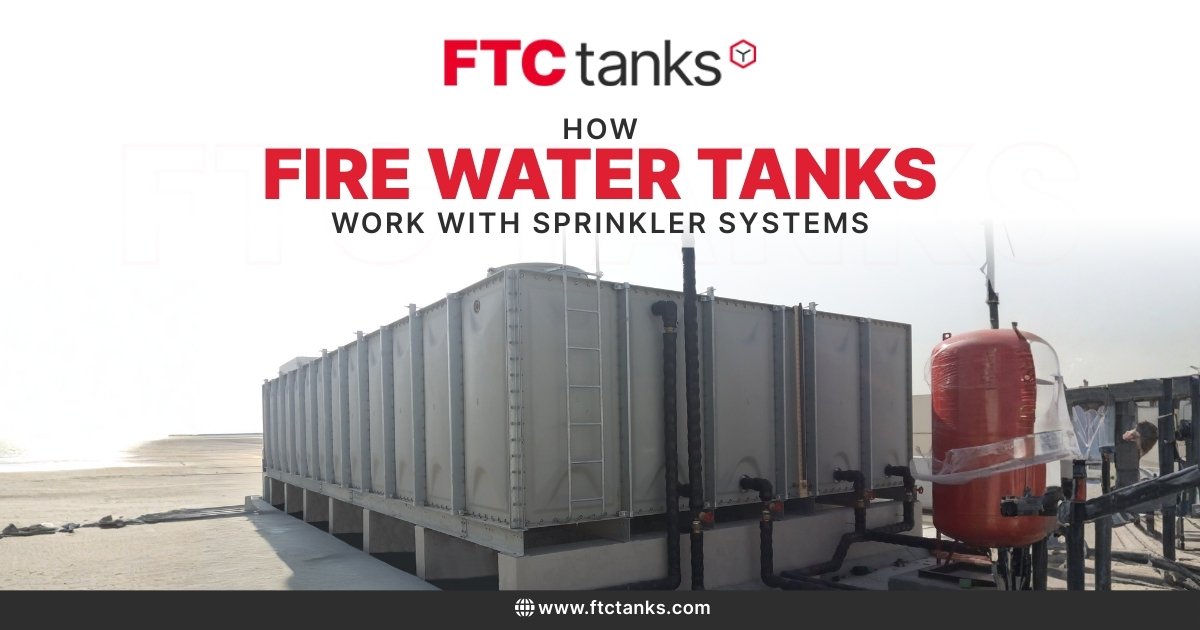
Fire protection systems are engineered with one primary objective: to control or suppress fire before it causes catastrophic damage. At the core of many commercial and industrial fire suppression systems lies one essential component: the fire water tank. While sprinklers are often the visible element of a building’s fire defense, they depend heavily on a reliable and properly designed water storage solution.
At FTC Tanks, we understand that an effective fire protection system begins with dependable water storage. In this article, we’ll break down how a Fire Water Tank works with sprinkler systems, the technical components involved, and why proper integration is critical for safety and compliance.
What Is a Fire Water Tank?
A Fire Water Tank is a dedicated water storage system specifically designed to supply water for fire suppression. Unlike domestic or process water tanks, this tank is reserved exclusively for emergency fire protection use.
These tanks are commonly installed in:
- Industrial facilities
- Warehouses
- Commercial buildings
- Manufacturing plants
- Residential complexes
- Infrastructure and utility sites
Their primary function is to ensure that sufficient water is immediately available when a sprinkler system activates.
The Core Components of a Sprinkler System
To understand how a Fire Water Tank works, it’s important to examine the sprinkler system itself. A typical fire sprinkler system includes:
- Water supply (Fire Water Tank or municipal supply)
- Fire pump
- Control valves
- Distribution piping
- Sprinkler heads
Each component must function seamlessly to deliver adequate water flow and pressure during a fire event.
How a Fire Water Tank Integrates with a Sprinkler System
1. Dedicated Water Storage
The Fire Water Tank stores a calculated volume of water based on:
- Building size
- Fire hazard classification
- Required discharge duration
- Local fire code requirements
This ensures that even if the municipal supply fails, the sprinkler system has a guaranteed water source.
2. Fire Pump Activation
When a sprinkler head detects heat (usually via a fusible link or glass bulb mechanism), it activates and allows water to flow. However, gravity alone is often insufficient to deliver the required pressure.
That’s where the fire pump comes in.
The sequence works as follows:
- A sprinkler head opens due to heat.
- System pressure drops.
- The pressure drop signals the fire pump controller.
- The fire pump draws water from the Fire Water Tank.
- Pressurized water flows through the sprinkler piping network.
Without the Fire Water Tank, the pump would have no reliable source to draw from during an emergency.
3. Maintaining Required Flow and Pressure
Fire suppression systems are engineered according to strict hydraulic calculations. These calculations determine:
- Gallons per minute (GPM) required
- Minimum operating pressure
- Duration of water discharge
The Fire Water Tank must hold enough water to meet these requirements for the entire design duration, often 30 to 120 minutes depending on risk classification.
At FTC Tanks, tanks are engineered to meet these operational demands with structural integrity and corrosion resistance.
Why Municipal Water Alone Is Not Enough
Many assume that a city water line is sufficient. However, there are several risks:
- Pressure fluctuations
- Insufficient flow during peak demand
- Infrastructure failure during disasters
- Utility shutdowns
A Fire Water Tank eliminates these uncertainties by providing a controlled and dedicated water reserve.
Types of Fire Water Tanks Used with Sprinkler Systems
Different applications require different tank configurations. Common types include:
Above-Ground Steel Tanks
Highly durable and ideal for industrial and commercial properties.
Bolted Panel Tanks
Modular systems that allow easy transportation and onsite assembly.
Underground Concrete Tanks
Used where space or aesthetic concerns require concealed storage.
GRP (Glass Reinforced Plastic) Tanks
Lightweight and corrosion-resistant for specific environments.
At FTC Tanks, tank selection is based on project specifications, environmental conditions, and compliance standards.
Key Design Considerations
Proper system integration requires more than just installing a tank. Engineering considerations include:
Capacity Calculation
Determined by fire code and hydraulic modeling.
Suction Pipe Design
Properly sized piping ensures efficient pump operation.
Anti-Vortex Plates
Prevent air from entering the pump suction line.
Overflow and Drain Systems
Ensure safe management of excess water.
Seismic and Wind Load Compliance
Critical in certain geographic regions.
Each of these factors ensures that the Fire Water Tank performs reliably under emergency conditions.
How the System Performs During a Fire Event
To visualize the process clearly:
- A fire generates heat.
- A nearby sprinkler head activates.
- Water pressure drops in the system.
- The fire pump starts automatically.
- Water is drawn from the Fire Water Tank.
- Pressurized water is discharged through active sprinkler heads.
- Fire growth is controlled or suppressed.
The tank continues supplying water until:
- The fire is extinguished.
- The system is manually shut down.
- The tank reaches its minimum operational level.
Maintenance and Inspection Requirements
A Fire Water Tank is not a “set it and forget it” system. Routine inspection is essential to ensure readiness.
Best practices include:
- Monthly visual inspections
- Annual internal inspection (if required)
- Checking inlet and outlet valves
- Verifying water levels
- Inspecting corrosion protection systems
- Testing pump suction lines
Regulatory standards such as those established by the National Fire Protection Association (NFPA) provide guidance on inspection and maintenance schedules.
Proper maintenance ensures that when the sprinkler system activates, the Fire Water Tank performs without failure.
Advantages of a Dedicated Fire Water Tank
Installing a Fire Water Tank with a sprinkler system provides:
- Guaranteed emergency water supply
- Code compliance
- Insurance benefits
- Improved property protection
- Reduced liability risk
- Operational continuity
For industrial and high-risk facilities, it is often mandatory rather than optional.
Compliance and Regulatory Standards
Fire protection systems must meet local building codes and international standards. Depending on jurisdiction, compliance may include:
- NFPA standards
- FM Global guidelines
- Local fire authority requirements
- Insurance carrier specifications
Working with experienced providers like FTC Tanks ensures that tank design aligns with these regulations.
Why Quality Matters
During a fire, there is no margin for structural failure or system malfunction. A poorly designed or undersized Fire Water Tank can compromise the entire sprinkler system.
Critical quality factors include:
- Corrosion-resistant coatings
- Structural engineering certification
- Proper foundation design
- Leak-proof panel connections
- High-quality fittings and valves
At FTC Tanks, we prioritize engineered reliability to ensure that every Fire Water Tank supports optimal sprinkler performance.
Final Thoughts
A sprinkler system is only as reliable as its water source. While sprinkler heads and pumps often receive the most attention, the Fire Water Tank is the backbone of the entire system. It guarantees water availability, stabilizes pressure, and ensures compliance with fire protection standards.
By integrating a properly engineered Fire Water Tank with a sprinkler system, facilities significantly enhance their fire resilience and operational safety.
For businesses seeking dependable fire protection infrastructure, partnering with specialists like FTC Tanks ensures long-term performance, regulatory compliance, and peace of mind.