
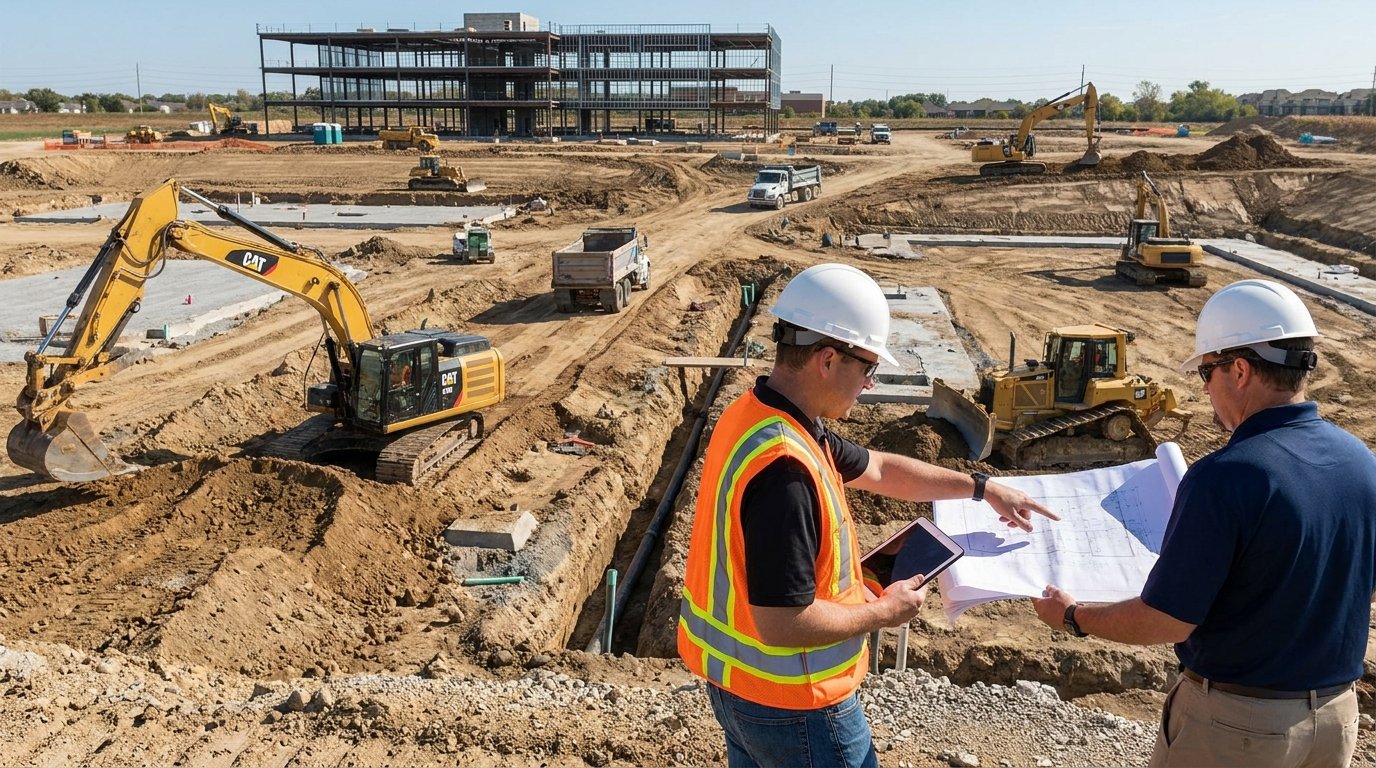
Sitework estimating services in USA help contractors convert civil drawings, grading plans, utility layouts, specifications, and existing-site information into measurable quantities and realistic project costs. The work can include much more than excavation. Grading, cut and fill, trenching, utilities, drainage, paving, aggregate, erosion control, hauling, and site restoration may all become part of the estimate.
That makes sitework one of the trades where an apparently small quantity error can affect several other parts of the bid.
A missed excavation volume can change hauling requirements. An incorrect trench length can affect pipe, bedding, backfill, and labor. A grading change can alter both cut and fill quantities.
A useful estimate needs to connect those relationships before the bid is submitted.
Sitework Is Broader Than Earthwork
Sitework estimating services generally cover the work required to prepare and develop a construction site.
Earthwork is an important part of that scope, but it is not the entire scope.
Sitework can include:
- Clearing and grubbing
- Demolition
- Topsoil stripping
- Excavation
- Cut and fill
- Grading
- Backfilling
- Soil stabilization
- Utility trenching
- Storm drainage
- Sanitary sewer
- Water lines
- Aggregate base
- Asphalt paving
- Concrete paving
- Curbs and sidewalks
- Erosion and sediment controls
- Site restoration
The exact scope depends on the project documents and the contractor’s responsibilities.
That distinction matters because an estimator who calculates only dirt quantities can leave significant portions of the site package unpriced.
Existing Ground Is the Starting Point
Sitework estimating begins with understanding what is already on the property.
The estimator may review:
- Existing topographic surveys
- Boundary surveys
- Grading plans
- Civil site plans
- Utility plans
- Geotechnical reports
- Drainage plans
- Landscape plans
- Demolition plans
- Specifications
- Project notes
The existing topography is particularly important for earthwork.
A grading plan describes the proposed condition, but the estimate needs to compare that proposed condition with the existing ground.
This is what allows the estimator to determine where material is being removed and where additional material is required.
The Federal Highway Administration’s earthwork guidance emphasizes that earthwork calculations depend on existing conditions, grading information, soil characteristics, shrink and swell, topsoil stripping, backfill availability, and other project-specific factors.
Earthwork Estimating Services Depend on Cut and Fill
Earthwork estimating services focus heavily on the movement of soil and other excavated materials.
The basic questions are:
What needs to be excavated?
What can remain on site?
What can be reused?
What needs to be imported?
What needs to be hauled away?
A grading plan can produce cut and fill volumes, but those numbers still need to be interpreted in the context of the project.
For example, a site may appear balanced because the calculated cut volume is close to the fill volume.
That does not automatically mean the project requires no imported material.
Soil may not be suitable for structural fill.
Shrinkage and swell can change usable quantities.
Topsoil may need to be stripped separately.
Some excavated material may have to leave the site.
These issues can materially affect the bid.
Earthwork Takeoff Services Need Soil Awareness
Earthwork takeoff services should identify more than a single excavation quantity.
Depending on the available information, the takeoff may separate:
- Topsoil stripping
- Common excavation
- Rock excavation
- Unsuitable material
- Structural excavation
- Fill
- Imported fill
- Exported material
- Backfill
- Subgrade preparation
- Aggregate
The geotechnical information can be particularly valuable here.
Soil type can influence excavation productivity, compaction, handling, reuse, and disposal.
The FHWA specifically recommends coordination with geotechnical information when developing earthwork quantities and notes that shrink/swell, stripping depth, and the suitability of on-site material should not simply be assumed.
That is a useful estimating principle for both large civil projects and building-site development.
Grading Changes the Cost Beyond the Dirt Quantity
Grading is not just another way of describing excavation.
The estimator needs to understand how the proposed elevations affect the site.
Grading can influence:
- Cut quantities
- Fill quantities
- Slopes
- Building pads
- Drainage
- Retaining structures
- Pavement subgrades
- Utility elevations
- Hauling requirements
Small elevation changes across a large site can create substantial differences in material movement.
This is why site work estimating should be based on the actual grading information rather than a simple assumption about the average depth of excavation.
Hauling Is Part of the Earthwork Equation
Moving soil has a cost beyond excavation.
The estimate may need to account for:
- Loading
- Truck capacity
- Haul distance
- Travel time
- Dump fees
- Imported material
- Traffic conditions
- Equipment productivity
- On-site stockpiling
The direction and distance of the haul can also affect productivity.
Material moved a short distance within the site is not the same operation as material that must be loaded, transported off site, and disposed of.
For a balanced-earthwork project, the estimator should therefore consider how the material will actually move rather than treating cut and fill as isolated numbers.
Utilities Require Their Own Takeoff
Site utilities can become a major part of the site package.
A utility takeoff may include:
- Domestic water
- Fire water
- Sanitary sewer
- Storm sewer
- Underground electrical
- Communications
- Gas
- Utility structures
- Manholes
- Catch basins
- Inlets
- Cleanouts
- Valve boxes
Trench length alone does not tell the complete story.
Depth, pipe size, bedding, backfill, trench protection, fittings, structures, and restoration can all affect the final cost.
The estimator should also review utility profiles and details when available because the plan view may not provide enough information about depth or elevation.
Drainage and Stormwater Should Not Be an Afterthought
Drainage systems connect site grading to the way water moves across the property.
Depending on the design, the site package may include:
- Storm pipes
- Catch basins
- Inlets
- Manholes
- Detention systems
- Retention systems
- Headwalls
- Swales
- Drainage structures
- Outfalls
- Erosion-control measures
Construction stormwater requirements can also affect the sitework scope.
The U.S. Environmental Protection Agency states that construction activities involving land disturbance can require stormwater permitting, including activities such as clearing, grading, and excavation, and that regulated projects may require erosion and sediment controls and pollution-prevention measures. Requirements vary depending on the applicable permitting authority and project circumstances.
U.S. EPA — Stormwater Discharges from Construction Activities
For estimating, the practical lesson is that erosion and stormwater-control items should be reviewed against the project documents instead of being assumed to be incidental.
Commercial Site Quantity Takeoffs Need More Organization
Commercial site quantity takeoff services often involve several connected scopes across a large property.
A commercial development may include:
- Building pads
- Parking areas
- Drive aisles
- Sidewalks
- Curbs
- Loading areas
- Utility networks
- Stormwater systems
- Retaining structures
- Landscaping preparation
- Site lighting infrastructure
Each area can have different materials and construction requirements.
For example, parking areas may require several aggregate and paving courses, while sidewalks may have different thicknesses and reinforcement requirements.
Organizing the quantities by area and construction phase makes the final estimate easier to review.
Paving Needs Thickness, Not Just Area
Paving quantities are often measured in square feet, but the estimate should also consider the specified section.
A pavement assembly can include:
Subgrade → Aggregate base → Asphalt or concrete surface
The thickness of each layer affects the material quantity.
An estimator should therefore review pavement details and specifications before applying a unit rate.
Other considerations may include:
- Milling
- Existing pavement removal
- Aggregate base
- Subbase
- Asphalt courses
- Concrete pavement
- Curb and gutter
- Striping
- Pavement restoration
A parking lot with a simple pavement section is a different estimating problem from a heavily trafficked commercial or industrial area.
Interior Sitework Needs a Clear Scope Definition
The phrase interior sitework estimating services can appear in estimating scopes where site-related work extends into or immediately around the building footprint, utility rough-ins, interior-connected civil work, or other site-development interfaces.
It is important not to confuse that terminology with interior building trades.
Sitework remains primarily concerned with the civil and exterior development scope.
When a project uses the term “interior sitework,” the estimator should verify exactly what the contract documents include.
That may involve:
- Utility connections
- Underground service runs
- Building-adjacent drainage
- Subgrade preparation
- Under-slab site-related work
- Interior-connected utility work
Clearly defining that boundary prevents the same work from being missed or counted twice by separate trades.
Soil and Site Conditions Can Change Productivity
A site estimate should account for conditions that affect how the work will be performed.
Potential variables include:
- Rock
- Clay
- Wet soils
- Unsuitable material
- High groundwater
- Steep slopes
- Existing utilities
- Congested areas
- Limited access
- Difficult haul routes
These conditions can influence equipment selection and production rates.
A large excavator may work efficiently on an open site but become impractical in a confined area.
Similarly, a project with limited truck access may have different hauling productivity from a site with direct access to a major roadway.
An estimator should identify these conditions where the project documents provide enough information to do so.
Sitework Estimating Should Connect Equipment to Production
Sitework is equipment-intensive.
Depending on the scope, equipment may include:
- Excavators
- Bulldozers
- Loaders
- Graders
- Rollers
- Skid steers
- Water trucks
- Dump trucks
- Trenchers
- Compaction equipment
The estimate should consider how long equipment will be needed and what work each machine is expected to perform.
The FHWA’s earthwork documentation illustrates how excavation and embankment work can involve different equipment for hauling, grading, placement, and compaction.
This is more useful than assigning a generic equipment allowance to the entire site.
Pricing Should Follow the Project Location
Sitework costs can vary significantly between markets.
Labor, equipment rental, trucking, disposal, aggregate, imported fill, asphalt, concrete, and utility materials may all have different local costs.
That makes location important when developing a bid.
A contractor estimating a suburban development should not automatically use the same hauling assumptions as a contractor working on a dense urban site.
This becomes particularly relevant for sitework estimate services NYC.
New York City projects can involve restricted access, dense existing infrastructure, traffic considerations, limited staging space, and complicated disposal or delivery logistics.
The estimate should reflect the actual project conditions rather than simply applying a national sitework unit rate.
Digital Takeoffs Help Track Large Civil Sets
Modern digital takeoff tools can measure and organize large civil drawing sets more efficiently.
Quantities can be separated by:
- Site area
- Material
- Utility
- Phase
- Structure
- Pavement section
- Excavation type
For earthwork, digital terrain and grading information can also support cut-and-fill calculations when the necessary data is available.
The important part is not simply using software.
The estimator still has to determine whether the source information is complete and whether the calculated quantities make sense.
A software-generated number based on incorrect or incomplete inputs is still an incorrect estimate.
What a Complete Sitework Estimate Can Include
A sitework estimate can be organized around the actual project scope.
Clearing and Demolition
Removal of vegetation, existing structures, pavement, and other designated site elements.
Earthwork
Topsoil stripping, excavation, cut and fill, unsuitable material, import, export, and backfill.
Grading
Building pads, slopes, subgrade preparation, berms, swales, and other grading requirements.
Utilities
Water, sewer, stormwater, electrical, communications, gas, structures, and related trenching.
Drainage
Pipes, inlets, manholes, detention or retention systems, outfalls, and related structures.
Paving
Aggregate, asphalt, concrete pavement, curbs, sidewalks, and restoration.
Erosion and Sediment Control
Silt fencing, inlet protection, stabilization, and other specified measures.
Equipment and Hauling
Excavation equipment, trucks, compaction equipment, haul distances, disposal, and imported material.
Assumptions and Exclusions
Clear documentation of missing information, scope boundaries, and items requiring clarification.
This organization allows the contractor to see how the site package was developed instead of receiving one unexplained sitework total.
When Expert Sitework Estimating Services Are Worth Considering
Sitework bids can consume considerable estimating time because the estimator has to coordinate civil plans, grading information, utility layouts, specifications, quantities, equipment, and local pricing.
Expert sitework estimating services can be useful when:
- Several civil bids have overlapping deadlines
- A project includes extensive grading
- Utility quantities are difficult to measure
- The civil drawing set is large
- Internal estimating staff is overloaded
- The contractor is entering a new market
- A revised plan requires a rapid quantity update
The outside estimator can prepare the complete sitework estimate or focus on a specific portion such as earthwork, utilities, paving, or drainage.
How All State Estimation Supports Sitework Bids
All State Estimation provides sitework estimating services for contractors, excavation subcontractors, civil engineers, developers, project managers, municipal contractors, and other construction professionals.
Its published sitework scope includes earthwork, cut-and-fill calculations, grading, utility trenching, drainage, paving, erosion control, and site development quantities. The service also distinguishes earthwork from broader sitework and offers standalone earthwork takeoffs when full pricing is not required.
The company’s published workflow combines civil drawings with existing-grade information, digital quantity measurement, project-location pricing, and a secondary review of the takeoff. Its listed deliverables include Division 31/32-coded Excel breakdowns, marked-up civil drawings, labor/material/equipment costs, equipment-hour estimates, and documented assumptions and exclusions.
For contractors needing broader support, the same service can also address commercial site quantities, utility work, drainage, paving, and earthwork within one coordinated estimating package.
Frequently Asked Questions
What are sitework estimating services in USA?
They are professional estimating services used to calculate quantities and costs for earthwork, grading, utilities, drainage, paving, clearing, erosion control, and other site-development work.
What is the difference between sitework and earthwork?
Earthwork generally focuses on excavation, cut, fill, grading, and movement of soil or other materials. Sitework is broader and can include earthwork plus utilities, drainage, paving, erosion control, and other site-development scopes.
What do earthwork takeoff services include?
They can include topsoil stripping, excavation, cut and fill, unsuitable material, rock excavation, backfill, imported fill, exported material, and subgrade preparation depending on the project documents.
Why are existing topography and grading plans important?
Existing topography provides the starting ground condition, while grading plans show the proposed condition. Comparing them helps determine where excavation and fill are required.
Do sitework estimates include utilities?
They can. Water, sanitary sewer, stormwater, electrical, communications, gas, utility structures, trenching, bedding, and backfill can be included when they fall within the estimating scope.
What are commercial site quantity takeoff services?
They are detailed quantity takeoffs for commercial site-development work such as grading, utilities, drainage, parking areas, paving, curbs, sidewalks, and related site infrastructure.
What does sitework estimate services NYC involve?
It involves developing sitework quantities and costs for New York City projects while considering the actual project location, access, hauling, disposal, utility conditions, staging, and other documented site constraints.
Can sitework estimating be outsourced?
Yes. Contractors can outsource a complete sitework estimate or individual scopes such as earthwork, utility takeoffs, grading, drainage, paving, or quantity measurement.
What information is needed for a sitework estimate?
Civil plans, grading plans, topographic surveys, utility drawings, geotechnical information, specifications, details, addenda, and project location provide a strong basis for estimating.
A Sitework Estimate Should Tell the Story of the Site
Sitework is where the design meets the existing ground.
That is what makes it different from many building trades.
The estimator has to understand where the site starts, where it needs to finish, how much material has to move, what can remain on site, where utilities need to go, how water will be controlled, and how the finished surfaces will be constructed.
A cut-and-fill calculation by itself does not answer all of those questions.
Neither does a utility quantity or a paving area.
A useful sitework estimate connects the quantities into the way the site will actually be built.
That means accounting for earthwork, grading, hauling, utilities, drainage, paving, equipment, local conditions, and documented scope boundaries.
When those elements are measured and organized properly, contractors have a much stronger basis for pricing the project, comparing subcontractor quotes, planning resources, and submitting a competitive bid.