

In surgical procedures, medical professionals rely on specialized instruments to control bleeding, secure blood vessels, and maintain a clear operating field. Among the commonly used instruments are Kelly clamps and hemostats. Although people sometimes use these names interchangeably, they do not always describe the same instrument. Understanding kelly clamp vs hemostat helps medical students, healthcare professionals, and surgical instrument buyers recognize the differences in design, function, and application.
Both instruments play an important role in surgical settings. However, their jaw patterns, locking mechanisms, and intended uses can vary depending on the instrument type. Therefore, learning their characteristics helps professionals select appropriate instruments for different surgical tasks.
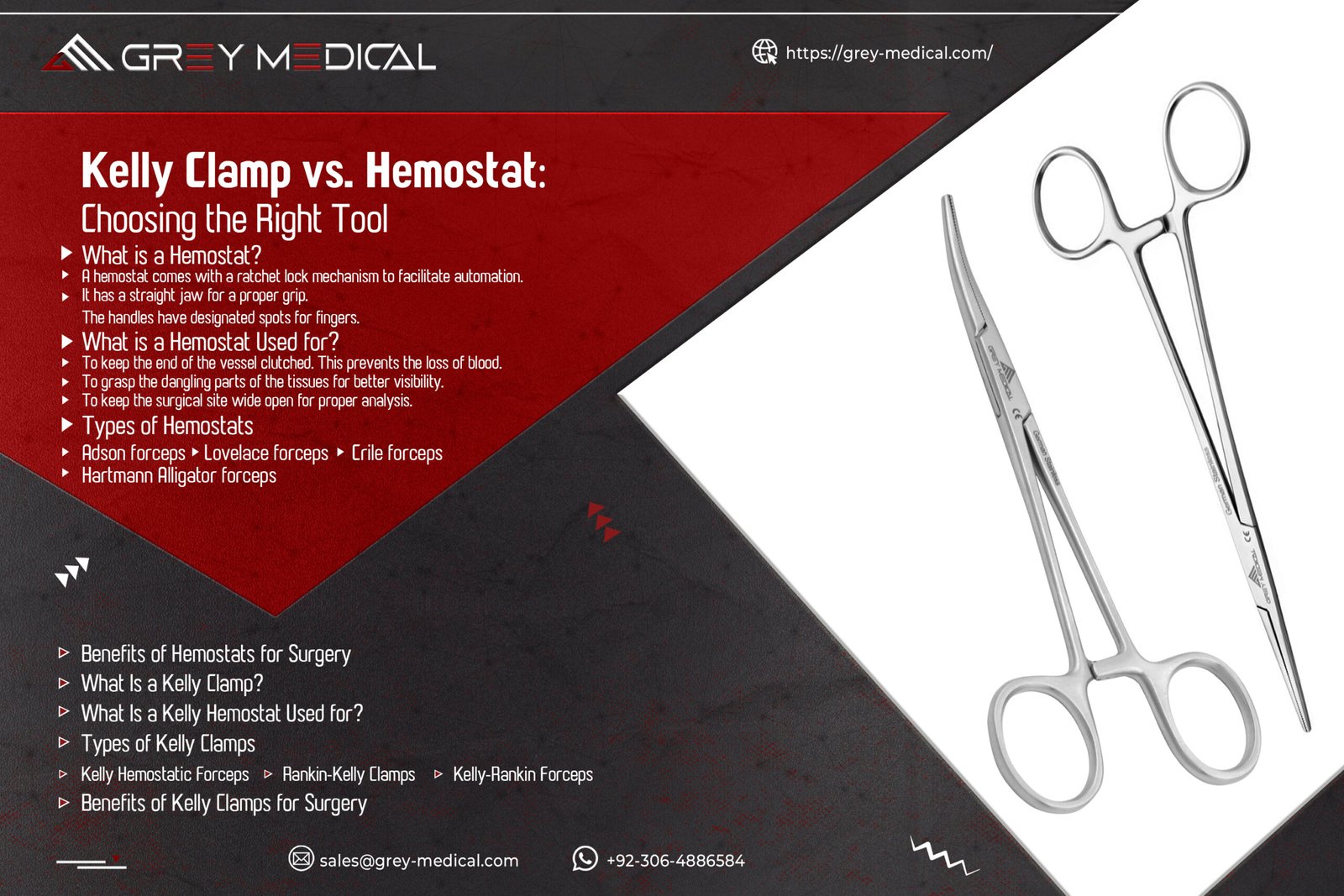
What Is a Kelly Clamp?
A Kelly clamp is a surgical instrument designed primarily to clamp blood vessels, control bleeding, and grasp tissue during medical procedures. It usually features ring handles, a ratcheting locking mechanism, and straight or curved jaws. Its jaws commonly have transverse serrations that provide a secure grip.
One important characteristic of a Kelly clamp is its partial jaw serration. Typically, the serrations extend along approximately half of the jaw length, while the remaining portion stays smooth. This design distinguishes it from several other hemostatic instruments.
Furthermore, surgeons and medical professionals use Kelly clamps in general surgery and other clinical applications. They can help control bleeding by temporarily compressing blood vessels. Their practical design also makes them useful for holding small tissue structures when appropriate.
What Is a Hemostat?
A hemostat is a broader category of surgical instruments designed to control bleeding by clamping blood vessels or other structures. These instruments generally feature two handles, a locking ratchet, and gripping jaws.
However, hemostats come in several different styles and sizes. For example, mosquito hemostats have smaller jaws for delicate structures, while larger hemostats accommodate different surgical requirements.
Moreover, hemostats may have straight or curved jaws, depending on their intended application. Their serration patterns and overall dimensions also differ between models.
The term hemostat describes the instrument’s general function rather than one specific design. Consequently, a Kelly clamp is actually one type of hemostatic clamp.
Kelly Clamp vs Hemostat: Key Differences
Understanding kelly clamp vs hemostat becomes easier when examining their design and purpose. Although both instruments help control bleeding, their names represent different levels of classification.
A Kelly clamp refers to a particular style of hemostatic instrument. In contrast, a hemostat refers to the broader family of instruments used for bleeding control.
Here are some important differences:
1. Instrument classification: A Kelly clamp is a specific type of hemostat, whereas a hemostat includes several instrument designs.
2. Jaw serrations: Kelly clamps typically feature serrations along approximately half of their jaw length. Other hemostats may have different serration patterns depending on their design.
3. Available sizes: Hemostats are available in various sizes, including delicate mosquito patterns and larger clamping instruments. Kelly clamps also come in different sizes and configurations.
4. Surgical applications: Kelly clamps commonly support general surgical tasks involving vessel clamping and bleeding control. Other hemostats may serve more specialized purposes.
5. Instrument identification: The Kelly name identifies a particular pattern, while the hemostat name identifies the instrument’s overall category.
Therefore, professionals should consider these differences when selecting instruments for specific procedures.
Common Types of Hemostats and Their Uses
Several hemostatic instruments serve different surgical requirements. Knowing their names helps medical professionals understand the available options.
Kelly Clamp: This instrument features partially serrated jaws and a locking mechanism. It commonly supports vessel clamping and general surgical applications.
Mosquito Hemostat: A mosquito hemostat has smaller, delicate jaws. Surgeons use it when they need to clamp smaller blood vessels or handle delicate structures.
Crile Hemostat: A Crile hemostat generally features full-length jaw serrations. It provides a secure grip and supports various general surgical applications.
Halsted Hemostat: Commonly associated with mosquito-style instruments, the Halsted hemostat offers a smaller design for delicate clamping tasks.
Rochester-Pean Hemostat: This larger instrument provides a stronger gripping structure for applications that require a more substantial clamp.
Although these instruments share similar features, their sizes and jaw designs make them suitable for different surgical needs.
How to Choose the Right Surgical Clamp
Choosing an appropriate surgical clamp requires attention to several factors. First, medical professionals should consider the procedure and the size of the structures they need to handle.
Next, they should examine the instrument’s jaw design. Straight jaws provide direct access, while curved jaws can help reach structures in areas where positioning is more challenging.
Additionally, the locking mechanism should operate smoothly and maintain a secure grip. High-quality stainless steel construction, reliable alignment, and durable joints also contribute to instrument performance.
Before selecting kelly clamp vs hemostat, healthcare professionals should understand that the Kelly clamp belongs to the hemostat family. Therefore, the best choice depends on the required instrument pattern rather than simply comparing two unrelated products.
Proper cleaning, inspection, sterilization, and maintenance are equally important. Following the manufacturer’s instructions and applicable clinical protocols helps maintain instrument quality and reliability.
Why Quality Matters in Surgical Instruments
Surgical instruments must meet demanding standards for precision, durability, and functionality. Even small differences in jaw alignment, serration quality, or locking performance can influence instrument handling.
Therefore, healthcare facilities should source instruments from dependable manufacturers that prioritize quality control and consistent production standards.
Grey Medical® is a privately owned medical technology company dedicated to innovation and excellence in the craft of surgical instrument. The company focuses on providing precision-crafted surgical instruments designed to support the needs of medical professionals and healthcare facilities.
Furthermore, selecting well-manufactured instruments and maintaining them correctly can help healthcare teams support consistent surgical practices.
Conclusion
Understanding kelly clamp vs hemostat helps medical professionals identify surgical instruments and choose appropriate designs for different applications. A Kelly clamp is a specific type of hemostat, while a hemostat represents a broader category of instruments used to control bleeding.
Although both terms relate to hemostatic functions, their classifications, jaw patterns, and available designs can differ. By understanding these characteristics, healthcare professionals can make more informed instrument selections. Ultimately, recognizing the correct surgical instrument names and choosing quality products contribute to better instrument management and effective surgical preparation.