

Introduction
The global textile manufacturing industry continues to evolve under the pressure of higher production efficiency, improved fabric quality, and reduced operational costs. Among the many innovations driving this transformation, the open-width circular knitting machine has become one of the most important developments in modern knitted fabric production.
Unlike conventional circular knitting systems that produce fabric in tubular form, open-width circular knitting machines are designed to deliver fabric in a flat, open-width state directly during the knitting process. This seemingly simple modification has a profound impact on downstream operations, significantly reducing the need for cutting, slitting, aligning, and reprocessing. As a result, manufacturers achieve more streamlined production workflows, improved material utilization, and enhanced consistency in fabric quality.
In today’s competitive textile environment—where speed, precision, and cost efficiency determine profitability—open-width circular knitting technology plays a strategic role in bridging traditional knitting methods with modern industrial demands.
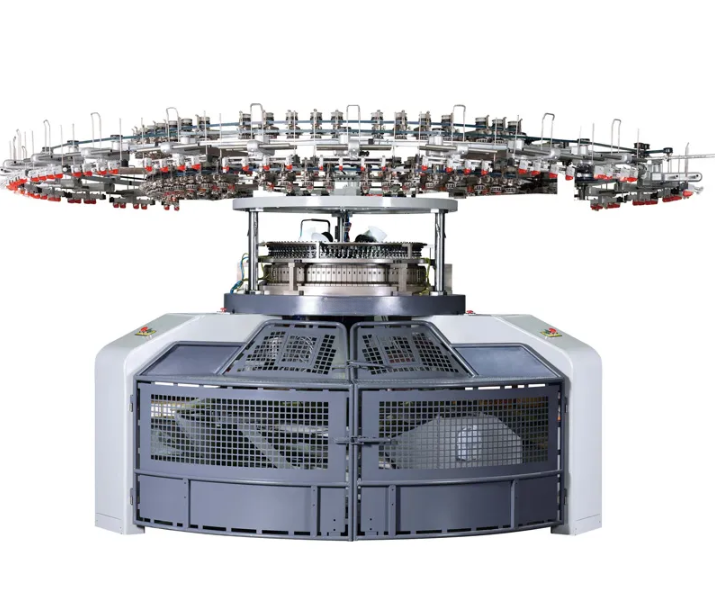
What Is an Open-Width Circular Knitting Machine?
An open-width circular knitting machine is a specialized textile production system that integrates traditional circular knitting principles with an advanced fabric opening and take-down mechanism. While conventional circular knitting machines produce seamless tubular fabric, this upgraded system modifies the output process so that the fabric is immediately converted into a flat sheet during production.
At the core of the system is a synchronized opening device that cuts and spreads the knitted tube into an open-width format. This eliminates the need for post-production slitting, a step that traditionally introduces risks such as uneven edges, distortion, or center crease formation.
Key Functional Advantages
The defining advantage of this machine lies in its ability to improve both efficiency and fabric quality simultaneously:
- Elimination of center creases: Fabric is opened immediately after knitting, avoiding compression marks.
- Reduced post-processing: Cutting, aligning, and rehandling steps are significantly minimized.
- Improved fabric consistency: Controlled tension ensures uniform texture across the entire roll.
- Higher production efficiency: Continuous knitting and opening reduce downtime.
- Lower labor requirements: Automation decreases manual handling.
By integrating knitting and fabric opening into a single continuous process, manufacturers can significantly optimize production flow while maintaining consistent output quality.
Types of Open-Width Circular Knitting Machines
Different production requirements in the textile industry have led to the development of multiple configurations of open-width circular knitting machines. Each type is designed to meet specific fabric structures, end-use applications, and performance characteristics.
1. Single Jersey Open-Width Circular Knitting Machine
The single jersey open-width circular knitting machine is one of the most widely used configurations in the industry. It is designed to produce lightweight, single-layer knitted fabrics with smooth surfaces and high flexibility.
Key Features
- Single needle bed structure
- High-speed operation capability
- Optimized yarn feeding system
- Stable open-width take-down system
Fabric Characteristics
Fabrics produced by this machine typically exhibit:
- Soft handfeel
- High breathability
- Lightweight structure
- Smooth surface texture
Applications
Due to its versatility, single jersey fabric is widely used in:
- T-shirts and casual wear
- Sportswear and activewear
- Underwear and intimate apparel
- Lightweight fashion garments
Industry Value
The single jersey open-width machine is especially valuable in mass production environments where consistency and speed are critical. Its ability to maintain stable fabric width while minimizing distortion makes it ideal for high-volume apparel manufacturing.
2. Double Jersey Open-Width Circular Knitting Machine
The double jersey open-width circular knitting machine is designed for producing more complex and structurally stable fabrics. It features a dual needle cylinder configuration that allows for the creation of thicker and more durable textiles.
Key Features
- Dual needle cylinder system
- Enhanced fabric structure control
- High elasticity and density capability
- Strong dimensional stability
Fabric Types Produced
This machine is capable of producing:
- Interlock fabrics
- Rib structures
- Double-faced textiles
- Structured knitted patterns
Applications
Double jersey fabrics are commonly used in:
- High-end fashion apparel
- Outerwear and jackets
- Stretchable garments requiring durability
- Premium textile products
Industry Value
The ability to produce high-density fabrics with excellent elasticity makes this machine essential for manufacturers targeting premium apparel markets. It provides a balance between strength and comfort, ensuring long-term garment performance.
3. High Pile Open-Width Circular Knitting Machine
The high pile open-width circular knitting machine is a specialized system designed for producing textured and plush fabrics. It focuses on creating raised fiber surfaces that enhance softness, insulation, and aesthetic appeal.
Key Features
- Advanced pile yarn control system
- High precision loop formation
- Stable density regulation
- Enhanced fabric surface finishing capability
Fabric Types Produced
This machine is ideal for producing:
- Terry fabrics
- Fleece materials
- Velvet-like textiles
- Plush knitted surfaces
Applications
High pile fabrics are widely used in:
- Home textiles (blankets, cushions, upholstery)
- Bath textiles (towels, bathrobes)
- Winter clothing and thermal garments
- Luxury comfort-oriented products
Industry Value
The growing demand for comfort textiles has increased the importance of high pile knitting systems. These machines allow manufacturers to achieve soft texture and consistent pile height, which are essential for premium home and apparel products.
How an Open-Width Circular Knitting Machine Works
The operating principle of an open-width circular knitting machine is based on traditional circular knitting technology but enhanced with a specialized fabric handling system that converts tubular output into a flat structure in real time.
1. Basic Knitting Structure
At its foundation, the machine uses a circular needle arrangement to interloop yarn into a continuous tubular fabric. Yarn is fed through a series of feeders, where needles form loops in a synchronized motion, producing consistent knitted structures.
This process is similar to conventional circular knitting machines, ensuring compatibility with existing knitting technologies and yarn types.
2. Integrated Open-Width Conversion System
The most critical innovation in this machine is the open-width conversion mechanism. After the fabric is knitted in tubular form, it is immediately processed by a cutting and spreading device.
This system performs two essential functions:
- Longitudinal cutting of the tubular fabric
- Simultaneous spreading into a flat sheet
By integrating these steps into the knitting process itself, the machine eliminates the need for separate slitting machines or manual intervention.
Benefits of Real-Time Opening
- Prevents crease formation
- Maintains edge alignment
- Reduces fabric deformation risk
- Improves roll uniformity
3. Precision Fabric Take-Down System
A key component of the machine is the fabric take-down mechanism, which ensures controlled tension as the fabric is pulled downward after knitting.
To achieve high precision, the machine often includes:
- Tension rollers
- Speed-controlled take-down motors
- Edge alignment guides
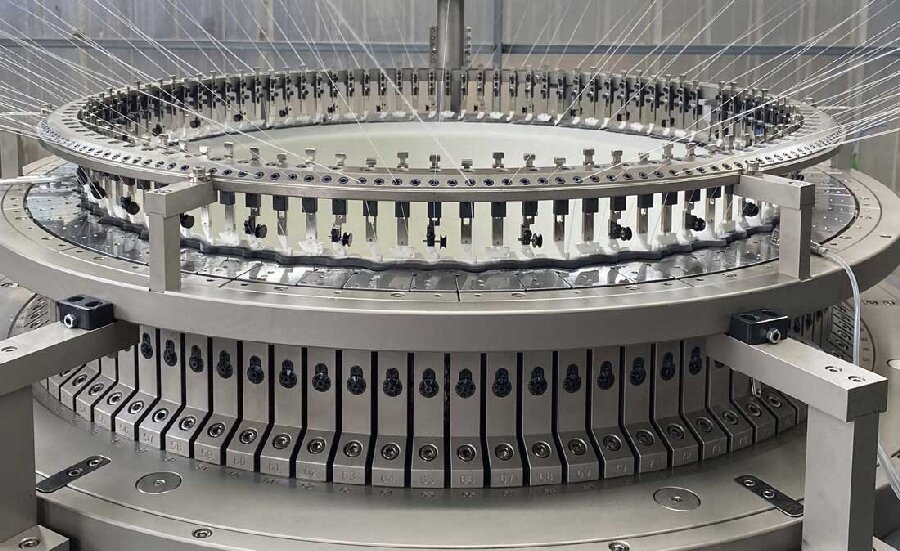
Additionally, the machine circumference is equipped with scale indicators that allow operators to monitor fabric width with high accuracy. This ensures that both edges of the fabric remain consistent throughout production.
4. Central Stitch Adjustment (CSA) Mechanism
One of the most advanced features found in modern open-width circular knitting machines is the Central Stitch Adjustment system.
This mechanism allows operators to precisely control stitch density across the fabric by adjusting loop formation settings centrally. Instead of manually calibrating multiple points, CSA enables synchronized adjustment across the entire knitting system.
Advantages of CSA Technology
- Simplified machine operation
- Faster adjustment times
- Improved fabric uniformity
- Reduced operator skill dependency
- Enhanced production stability
5. Continuous Production Flow
The entire system is designed for uninterrupted operation. Yarn feeding, loop formation, fabric cutting, and opening all occur in a continuous sequence.
This seamless workflow eliminates batch processing interruptions and significantly improves production efficiency. The result is a steady output of flat knitted fabric rolls ready for dyeing, finishing, or garment production.
Advantages of Open-Width Circular Knitting Technology
The adoption of open-width circular knitting machines brings multiple benefits to textile manufacturers:
1. Improved Fabric Quality
By eliminating tubular creases and ensuring even tension distribution, fabric quality is significantly enhanced.
2. Reduced Production Costs
Lower labor requirements and reduced post-processing steps directly decrease operational costs.
3. Higher Efficiency
Continuous knitting and opening improve production speed and reduce downtime.
4. Better Material Utilization
Precise fabric control minimizes waste and improves yield efficiency.
5. Enhanced Automation
Modern systems integrate electronic controls, reducing reliance on manual adjustments.
Industrial Applications of Open-width Circular Knitting Machine
Open-width circular knitting machines are widely used across multiple textile sectors:
- Apparel manufacturing
- Sportswear production
- Home textile production
- Industrial fabric manufacturing
- Fashion textile development
Their versatility makes them suitable for both mass production and high-end textile applications.
Maintenance and Operational Considerations
To ensure long-term performance, proper maintenance is essential.
Key Maintenance Practices
- Regular needle inspection and replacement
- Lubrication of moving mechanical components
- Calibration of tension and take-down systems
- Monitoring of yarn feeding consistency
- Cleaning of fabric cutting mechanisms
Preventive maintenance not only extends machine lifespan but also ensures consistent fabric quality.
Market Trends and Future Development
The open-width circular knitting machine market is expected to grow steadily as manufacturers seek greater automation and efficiency. Several trends are shaping its future:
1. Smart Textile Manufacturing
Integration with IoT systems enables real-time monitoring and predictive maintenance.
2. Energy Efficiency Improvements
New designs focus on reducing power consumption while maintaining high output levels.
3. Advanced Fabric Control Systems
Digital stitch adjustment and AI-assisted calibration are becoming more common.
4. Demand for High-Quality Fabrics
Rising consumer expectations are pushing manufacturers toward more precise knitting systems.
Conclusion
The open-width circular knitting machine represents a significant advancement in textile manufacturing technology. By combining traditional circular knitting methods with modern fabric opening and control systems, it delivers superior efficiency, improved fabric quality, and reduced production complexity.
With its multiple configurations—including single jersey, double jersey, and high pile systems—it serves a wide range of industrial applications from basic apparel to premium home textiles. As automation and digital control continue to evolve, this machine type is expected to play an even more critical role in the future of textile production.
For manufacturers aiming to remain competitive in a fast-changing global market, adopting open-width circular knitting technology is no longer just an option—it is becoming a necessity.