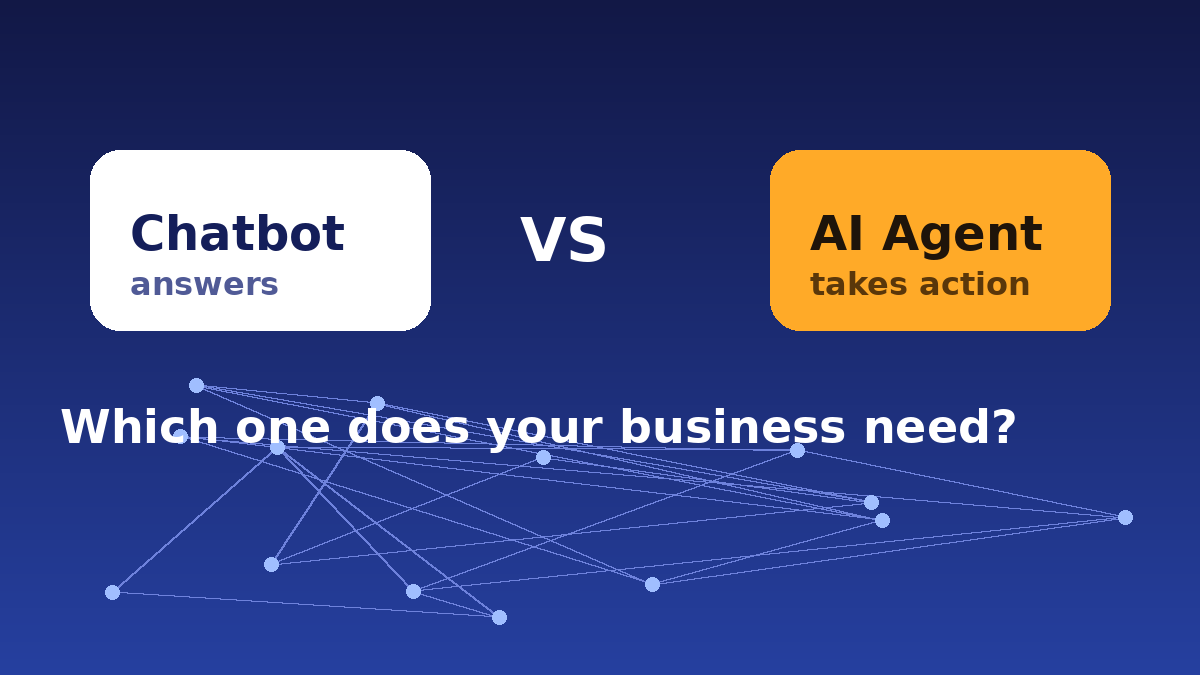
“Should we build a chatbot or an AI agent?” is one of the most common questions businesses ask when they start exploring AI. The two terms are often used interchangeably, but they solve different problems, cost different amounts and need different levels of data and integration. Here is how to decide.
What is an AI chatbot?
An AI chatbot answers questions in a conversation. It is trained on your FAQs, documents and policies, and it replies in natural language. Chatbots are ideal for customer support, lead qualification, internal help desks and any situation where the goal is to inform or guide a person.
What is an AI agent?
An AI agent goes further: it plans, uses tools and takes actions. It can look up an order, update a CRM record, draft and send a report, or trigger a workflow across several systems, with little human input. Agents suit multi-step processes in operations, sales, finance and data reporting.
Key differences at a glance
- Goal: a chatbot answers; an agent completes tasks.
- Integration: a chatbot needs a knowledge base; an agent needs secure access to your APIs, databases and tools.
- Risk and oversight: an agent that acts needs guardrails, approval steps and monitoring.
- Cost and timeline: chatbots are usually quicker and cheaper to launch; agents take more design and testing.
When a chatbot is enough
Choose a chatbot when most of your requests are repetitive questions with known answers, when you want to reduce support load quickly, and when your systems are not yet ready for deep integration.
When you need an agent
Choose an agent when the real cost sits in manual, multi-step work: reconciling data, routing tickets, qualifying and updating leads, or compiling reports from several sources.
Start small, then expand
Many teams begin with a chatbot to prove value and gather data, then add agent capabilities for the workflows that matter most. Whichever you choose, define success metrics first, such as resolution rate, hours saved or response time, and review performance regularly after launch.
About the author: The team at KriraAI, an AI development company, builds custom AI chatbots, AI agents and generative AI solutions for startups and enterprises. Visit www.kriraai.com to learn more.